

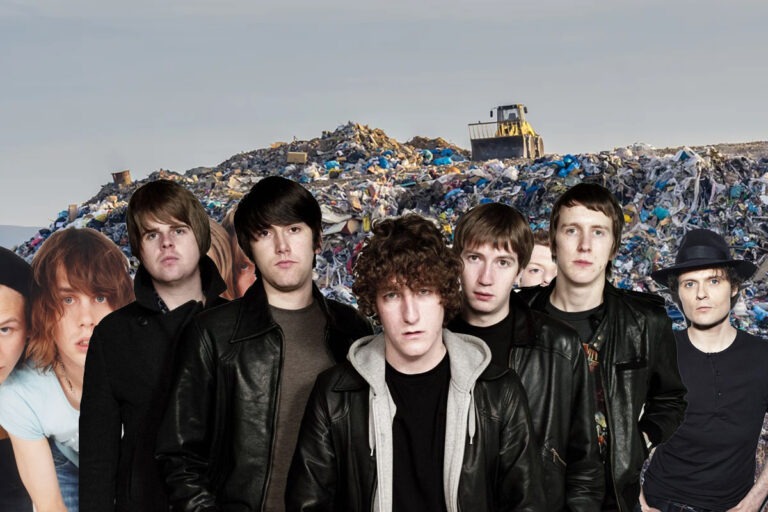

It is one of the most dismissive and enduring terms in British music writing. “Landfill indie” still raises a weary smile from anyone who lived through the mid-2000s glut of identikit guitar bands, all trying to ride the post-Libertines and Arctic Monkeys wave. But who actually invented the phrase?
Earlier this week a chase began across blogs, Bluesky, Instagram and the dusty back issues of music magazines. What started with a casual claim from journalist Andrew Harrison turned into a cultural detective story, one that pulled in internet detectives, fellow writers, and the ghosts of The Word magazine.
A term that stuck because the music didn’t
The reason “landfill indie” resonated was obvious to anyone who flicked through NME or tuned into Radio 1 between 2005 and 2008. Bands like The Kooks, Razorlight, The Pigeon Detectives, Hard-Fi, The View, The Fratellis, Scouting for Girls and The Enemy were everywhere. They played jaunty guitar riffs, sang laddish choruses about little more than pubs and girlfriends, and wore skinny jeans with undeserved confidence.
Each one was, to borrow Paul Morley’s old phrase about Factory Records, “copying the copy of the copy.” By the late 2000s, the British charts were so saturated with these acts that a single dismissive phrase was needed to sweep them away. “Landfill indie” did the job perfectly. Like a music festival littered with empty Strongbow cans, it conjured disposability, waste and the sense that none of this would be worth remembering in a decade. Yet the term also inadvertently captures something about its moment in time. The mid to late 2000s were still a period when CDs were stacked on shelves, music magazines filled the newsstands and bands were competing for limited physical space in shops as much as for attention online. That material culture of abundance and excess gave the phrase its sting. In today’s streaming landscape, where music is weightless and infinite, “landfill” feels less relevant because nothing piles up in quite the same way.
The claim: Andrew Harrison steps forward
Journalist Andrew Harrison (formerly of Mixmag, Q and The Word) became attached to the phrase “landfill indie” through repeated attributions, to the point where his own Twitter profile described him as its inventor. What stood out was not that his reputation made the claim plausible, but that almost nobody questioned it. The Guardian’s early coverage had linked his name to the phrase, and copycat reporting did the rest. Yet for years, no tangible evidence was ever produced. The lack of scrutiny was as striking as the attribution itself, and it was this gap that made the story worth chasing.
The moment the claim was made, doubt began to creep in. Was it really him? Or was “landfill indie” one of those phrases that emerges from the swamp of online discussion boards, hardened through repetition until no one can remember who said it first?
The hunt: from Bluesky to blogs to Instagram
That doubt sent me digging further. I couldn’t message Harrison directly, since his DMs were disabled, and there seemed no obvious way to get in touch. So I combed through his old Bluesky profile and eventually unearthed a four-month-old thread where he had replied to someone about landfill indie. I revived that conversation, hoping he might offer more clarity, or at least react to the renewed interest.
In the meantime, I started hunting for old copies of The Word magazine online, hoping to find any browsable or downloadable issues. Since I didn’t know the exact month the phrase appeared, pinpointing the right issue was impossible and honestly, it barely mattered given how scarce any trace of the text was. Then came a promising lead: Gavin Hogg, a music journalist who maintained a WordPress blog dedicated to sharing the contents of his collection of old physical magazines. His latest post was an issue of The Word from 2008, exactly the kind of source material I needed. I left a comment on his blog, but it stayed in moderation limbo. As I waited, I dug deeper to uncover his real identity, eventually tracking him down on Bluesky, where I sent a message and then waited again.
Failing to find a direct copy of the source material, I started looking for indirect references, hoping someone else might have a lead. Then I found it: a 2022 review of the Yard Act album The Overload by journalist Fergal Kinney for The Quietus. What made it stand out was that Kinney didn’t just reference the original The Word article, he quoted the specific line where “landfill indie” first appeared.
When the journalist Andrew Harrison first used the term ‘landfill indie’, it was in a 2008 album review of the Swedish musician Jens Lekman, saying his music “resembles an al fresco health farm next to our own blighted landscape of landfill indie.”
This was a big deal. Surely if anyone knew where to find the original source, it would be Fergal. The chase had just gotten a lot more interesting. It started to feel less like a trivial argument over terminology and more like a small cultural whodunnit.
Memory and ownership: the Britpop parallel
The uncertainty about “landfill indie” had an echo from the 1990s. Who invented the term “Britpop”? Both John Robb and Stuart Maconie have, at different times, claimed the honour. Robb used it early on in print, while Maconie popularised it through Select magazine’s famous Union Jack cover in 1993. To this day, neither has fully conceded ground.
The parallel is striking. Music journalism thrives on snappy labels, but those labels are often born messily, in the crossover between casual conversation, editorial shorthand and the broader cultural mood. Memory plays tricks, and no single person has clean ownership. What remains is often the pettiest part: who gets to claim credit.
The hope with “landfill indie” is that it does not descend into the same squabble. After all, it is a phrase designed to dismiss, not to glorify. To fight over it would be like two people bickering over who invented “nu metal” or “post-rock.” The point is not the ownership, but the cultural resonance.
In the meantime, Andrew had replied. The news was not good. His old copies of The Word were locked away in a storage unit in Liverpool, and he couldn’t remember the specific issue where the phrase appeared. The trail was already growing faint. I also heard back from Fergal. He confirmed that while he had seen the quote before writing his article, he didn’t have access to the original source. It was a definite setback. The search for a tangible, original copy of the article was looking less and less likely.
The breakthrough: a buried issue of The Word
Eventually, Gavin Hogg turned up what seemed to be the smoking gun. He shared an image from the September 2008 issue of The Word, where the term appeared in a subheading for a Glastonbury review. It was used in exactly the context we now know it: as a catchall for the glut of bands clogging up the airwaves. This felt like the answer, and at first, I was overjoyed.
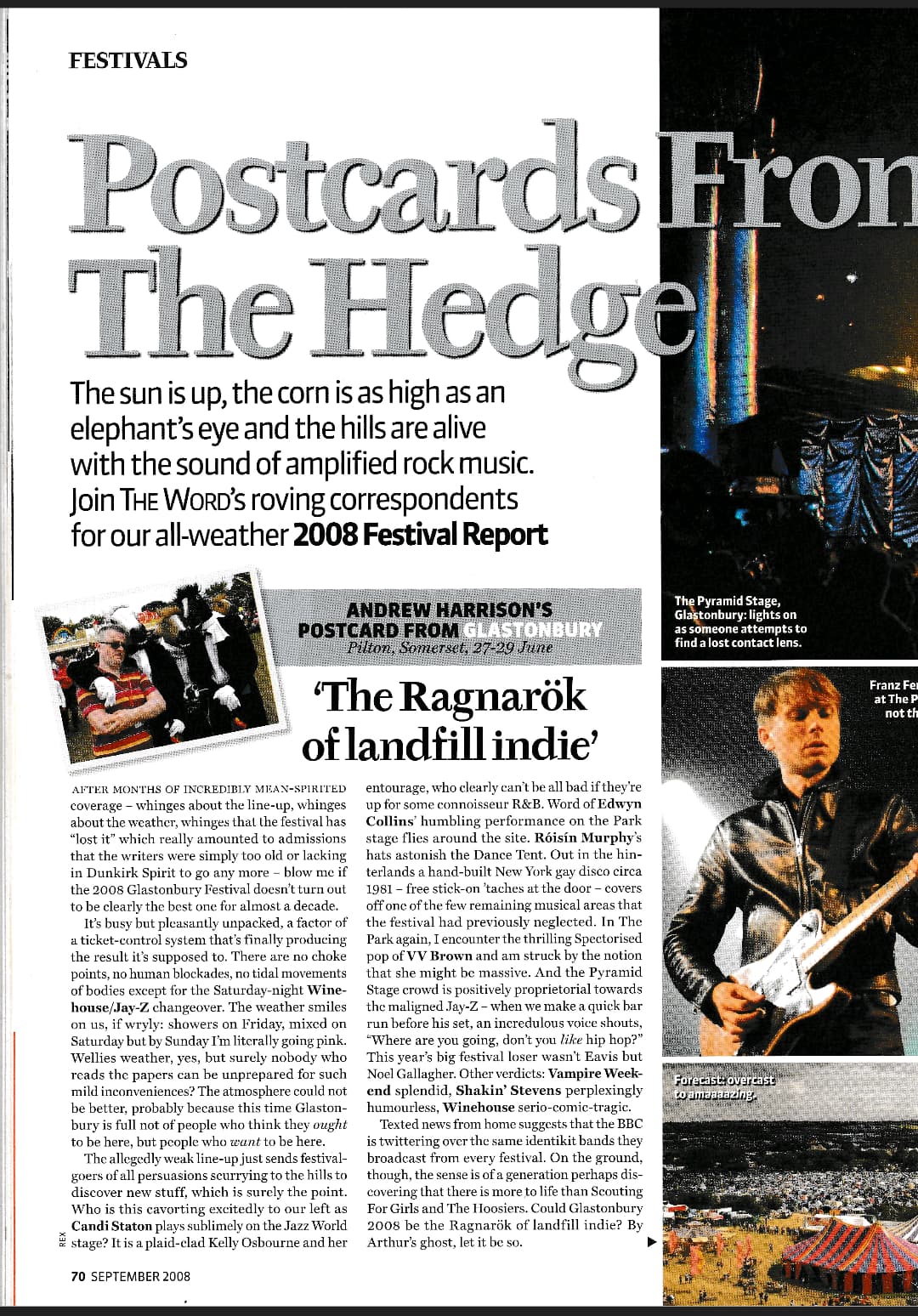
But a nagging thought lingered: September 2008 just felt too late. I was sure I’d seen references to “landfill indie” much earlier. The search began again. With help from the Wayback Machine, I unearthed an Independent article from July 20, 2008, a casualty of the era’s digital disposability. It mentioned “landfill indie” and “indie landfill” multiple times, not as a new phrase, but as a commonly used term. While this predated The Word‘s publication date, it postdated the Glastonbury festival it reviewed, muddying the waters.
My suspicions about Andrew’s claim grew. I found another reference to the term in an ireallylovemusic blog post from July 31, 2008, again presented as a common expression. A Drowned in Sound news story from December 9, 2007, even mentioned “landfill” alongside bands like The Enemy and The Pigeon Detectives. The evidence was piling up.
The final piece of the puzzle arrived when I found a feature in The Guardian about “wonky pop,” dated May 2, 2008. The article explicitly referenced “landfill indie” as if it was a commonly used term. Predating Andrew’s Glastonbury review by two months, this proved definitively that the September 2008 issue of The Word was not the origin point. The phrase was already in circulation. It was becoming clear that, like “Britpop,” the true origin of “landfill indie” might be lost to time. But one thing seemed certain: it wasn’t Andrew Harrison.
The Internet’s Echo Chamber
Despite a seemingly endless digital trail, a definitive source for the term “landfill indie” remained elusive. The internet was awash with claims, with countless articles from major publications and obscure blogs alike pointing to The Word magazine as the origin. Yet, a deeper investigation revealed only a self-referential echo chamber. One article would cite another, which in turn cited a third, but the chain of evidence never led back to a primary source. It was a digital ghost story, a term everyone was willing to claim had an origin, but no one could prove it. This frustrating dead end highlighted a common issue in our modern media landscape, where speed often takes precedence over verification. An easy, plausible narrative spreads unchecked, amplified by journalists under pressure to produce content for an insatiable web and social media machine.
In a world where online content is increasingly built on the foundations of other online content, this small mystery became a cautionary tale. The pursuit of the term’s origin was a stark reminder of how readily unverified information can calcify into accepted fact. The widespread propagation of the “landfill indie” origin story, while innocuous, was an example of how easily a collective narrative can be built on little more than assumption and repetition. It also highlighted a deeper truth about the music itself: the sheer volume of “landfill indie” was not just a natural boom but the result of a specific industry process. As Richard King noted in How Soon is Now, major labels, wary of missing out on the next big indie star, began signing a glut of bands to outflank independent labels like Domino and Rough Trade. This created an economic bubble of underdeveloped, identikit acts, and the term itself became a direct consequence of this oversaturated market. This chilling glimpse into a media ecosystem where truth is sometimes just a casualty of convenience, and even seemingly simple facts can be surprisingly difficult to pin down, was now revealed to be a symptom of a larger, systemic issue.
One more lead
Just when I had resigned myself to a dead end, a final, unexpected message arrived. It was from Gavin, whose own curiosity had apparently gotten the better of him. He had decided to give his archives one more desperate search. And then, the unthinkable happened: he found it. The smoking gun was a review of Jens Lekman‘s album Night Falls Over Kortedala, published in the November 2007 issue of The Word. Nothing I had found online dated that far back. The phrase “landfill indie” was right there, in print, in late 2007. I had been wrong to doubt Andrew. The origin story wasn’t just true; it was exactly as it had been referenced all along.
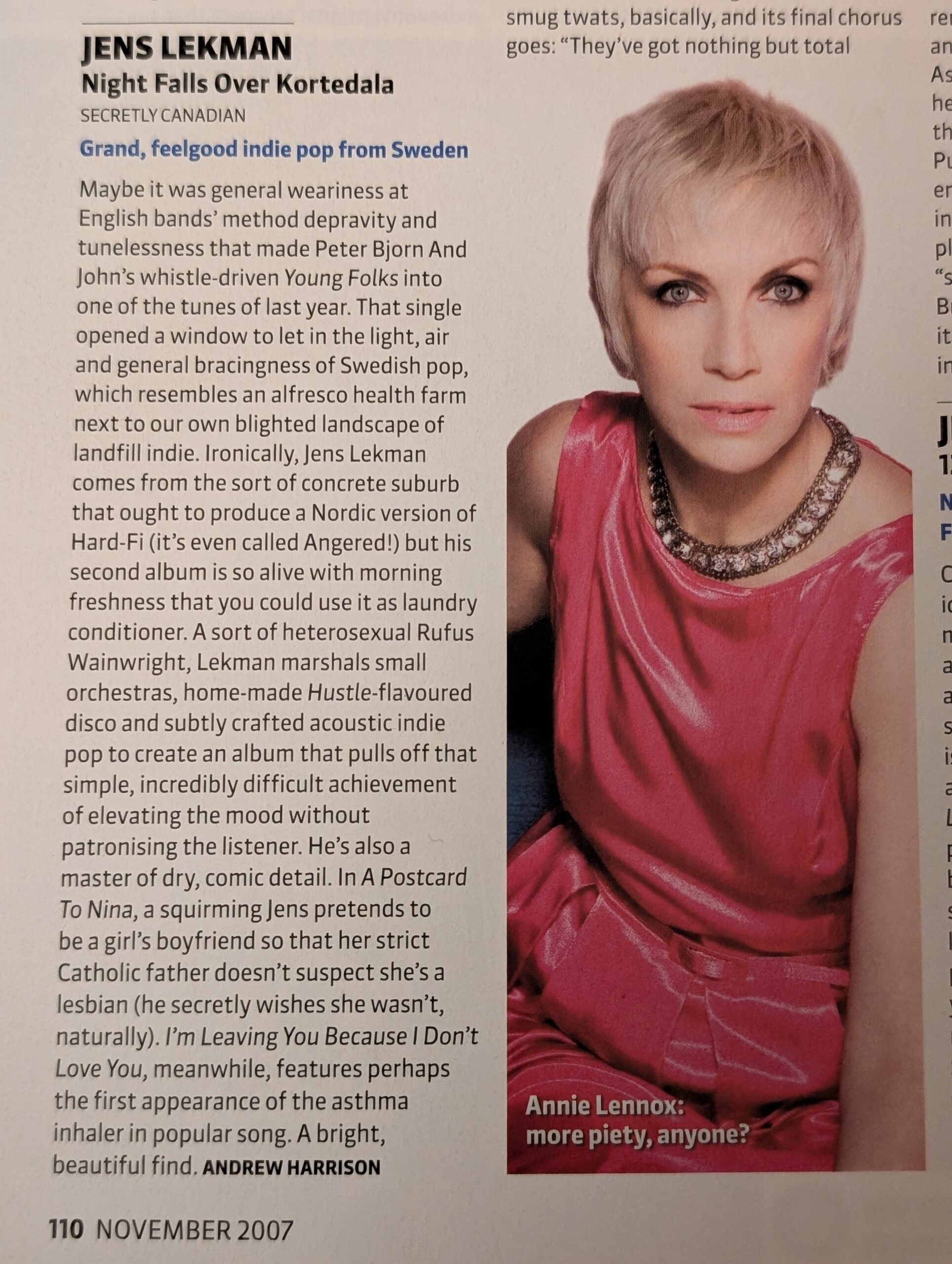
JENS LEKMAN
Night Falls Over Kortedala
SECRETLY CANADIAN
Grand, feelgood indie pop from Sweden
Maybe it was general weariness at English bands’ method depravity and tunelessness that made Peter Bjorn And John’s whistle-driven Young Folks into one of the tunes of last year. That single opened a window to let in the light, air and general bracingness of Swedish pop, which resembles an alfresco health farm next to our own blighted landscape of landfill indie. Ironically, Jens Lekman comes from the sort of concrete suburb that ought to produce a Nordic version of Hard-Fi (it’s even called Angered!) but his second album is so alive with morning freshness that you could use it as laundry conditioner. A sort of heterosexual Rufus Wainwright, Lekman marshals small orchestras, home-made Hustle-flavoured disco and subtly crafted acoustic indie pop to create an album that pulls off that simple, incredibly difficult achievement of elevating the mood without patronising the listener. He’s also a master of dry, comic detail. In A Postcard To Nina, a squirming Jens pretends to be a girl’s boyfriend so that her strict Catholic father doesn’t suspect she’s a lesbian (he secretly wishes she wasn’t, naturally). I’m Leaving You Because I Don’t Love You, meanwhile, features perhaps the first appearance of the asthma. inhaler in popular song. A bright, beautiful find. ANDREW HARRISON
What we learned from chasing the trash
This conclusion provides a stark contrast to the ongoing squabble over who coined “Britpop.” That mystery, born in the messy, pre-digital music scene of the 1990s, will likely never be resolved. It’s a reminder of how memory and attribution can blur without a solid record.
Our journey to find the origins of “landfill indie” shows a new kind of fragility. While plenty of digital content was being created in 2008, data and storage was still expensive and much of it wasn’t retained. This investigation became an unexpected look into how easily a surprising amount of information from our recent past has already been lost. We were only able to find the answer because of one person who, like a cultural historian, was holding onto the physical source material.
Thankfully, this story has a conclusion. We have a name and a date. But the final irony remains: who knows if this article will continue to exist online as a reference in another decade? It serves as a stark reminder of the disposable nature of even our digital history.
