

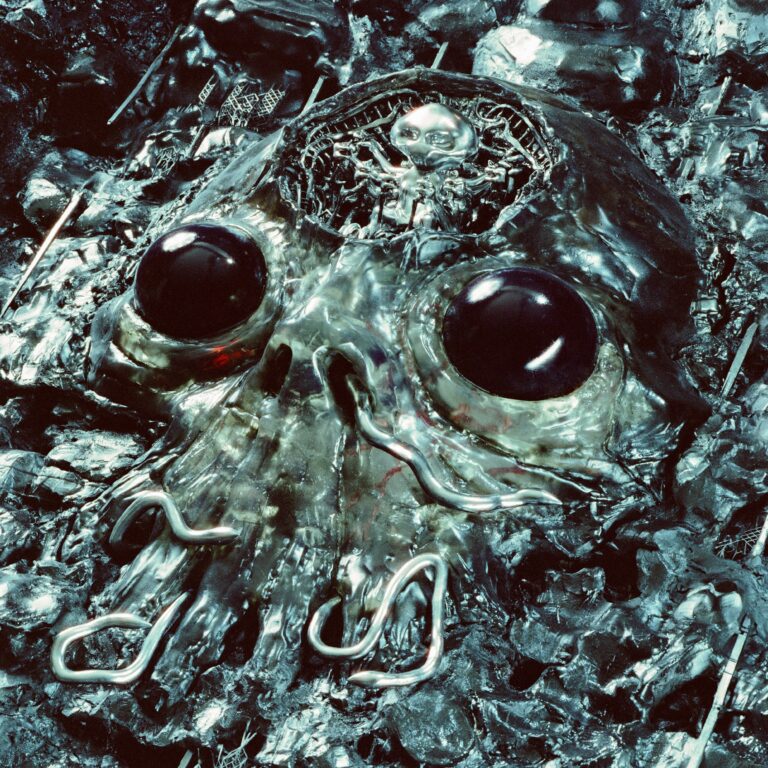

Forget everything you thought you knew about King Gizzard & the Lizard Wizard, because the Aussie six-piece have done the exact opposite of what you’d come to expect from them…again. After dipping their toes in orchestras and blues rock on previous two albums Phantom Island (2025) and Flight b741 (2024), Stu Mackenzie and co. have put down their live instruments in favour of analog synths and electronic music. It’s not unfamiliar territory for the band, and yet 28th album Alien Metal sounds everything and nothing like the King Gizzard & the Lizard Wizard we know. It avoids the clear structures present on 2023’s electronic monster The Silver Cord and 2021’s Butterfly 3000, rather opting to blend elements of both and apply them to a collection of eight, uptempo techno tracks which sound ready made for raves and underground parties. There is no clear semblance of a traditional album structure here, instead presenting itself as one big mega mix with eight distinct parts, all of which are connected, yet different.
It should come as no surprise that Alien Metal was conceived using the live synth rig the band have been touring with for the last couple of years. Dubbed Nathan, it’s essentially just one big fuck off table full of synths, pedals, knobs, and enough wires to give a bomb disposal expert anxiety. It’s become an increasingly prominent part of the King Gizzard live experience, serving as the focal point during last autumn’s European rave tour. There are a lot of elements heard across Alien Metal which can be directly linked back to the instrumental techno jams heard on tour last year, serving as a taste of what was to come. Album opener Sapience wastes no time in getting the party started, combining a high energy BPM with modulating synth arpeggios and pulsating percussion. This combination serves as the backbone (and overall formula) of the entire album: a fast tempo, synthesizers that envelope your ears, and percussion ranging from techno and jungle to hardcore and house. The lack of distinct structure (in the traditional sense) makes way for a constant beat, which carries on into title track Alien Metal. There’s a sense of urgency which prevails throughout the title track, in part due to a barrage of sonic quirks and unsettling vocals. Said vocals are laced with effects and vocoders, almost to the point where you can’t tell which band member is singing, and yet on Alien Metal a wave of psychedelia hits you during its makeshift chorus. Superheavy, Supercritical is (just like opener Sapience) completely instrumental, except for a chopped up vocal hook which isn’t so much catchy as it is repetitive. This repetition bleeds into Kill For the Steel, a powerhouse of a techno track with suitably haunting lyrics (“we don’t wish death upon you, but we will kill for the steel”) and euphoric passages which help bridge the gap between full on beats and wistful, space-like psychedelia. Singing exclusively using vocoders on the entire album is certainly a choice, but in this case it’s also the right choice.

Lead single Level 5 follows, having already been referenced towards the end of the preceding track. King Gizzard fans may have already been accustomed to hearing the band dabble in techno’s darker side with The Silver Cord, but nothing could have quite prepared them for Level 5. The techno is still there, but it’s been sidelined by a hefty dose of breakbeat which only serves to make everything just that little bit more frantic. Its unsettling music video is straight out of the Cronenberg handbook, featuring the band as orderlies in a cult-like surgical suite as veteran Australian actor Vince Colosimo operates on an alien. The band subsequently try to bring the alien back to life using – you guessed it – techno. Rapid Alpha Decay marks the first moment on Alien Metal where the listener gets the opportunity to breathe, operating on a somewhat more relaxed wavelength while still maintaining the tempo and tension of what came before. Arpeggiating synths weave in and out of one another throughout as the band profess their love for “the keeper of the energy” repeatedly. The end of the song transcends ever so slightly, but refrains from going all out as it flows into the standout Uqt. Darker synth lines and pulsating percussive rhythms underpin lyrics about electroshock therapy, scientific research and anaesthesia, initially sounding more brooding while tension gradually builds. As the vocals become more and more unhinged, Uqt enters full rave territory for a closing section that presents Alien Metal at its weirdest, yet most exciting. You’re left wondering what the actual fuck you’ve just listened to, which is a feeling presumably most King Gizzard fans have had at least once. The instrumental Atomic Collapse is the final track on Alien Metal, serving as a sonic amalgamation of the previous seven songs’ best bits. It flitters between a little bit of this and a little bit of that, fusing the harder techno elements with rave-worthy passages and creepy psychedelic undertones. It doesn’t build up to a big finale, instead choosing to go quietly into the night.
If aliens listened to metal, it would probably sound like this: jarring, otherworldly and just as much in your face as it is transcendental. The band are at their best when they allow their weirdness to sit at the forefront, particularly on the songs which are vocoder-heavy. Songs like the title track, Kill For the Steel and Uqt raise the bar so high that it makes songs like Superheavy, Supercritical and Atomic Collapse almost struggle in comparison. Alien Metal is not your typical King Gizzard & the Lizard Wizard album. But then again – what is?
7.5/10
