

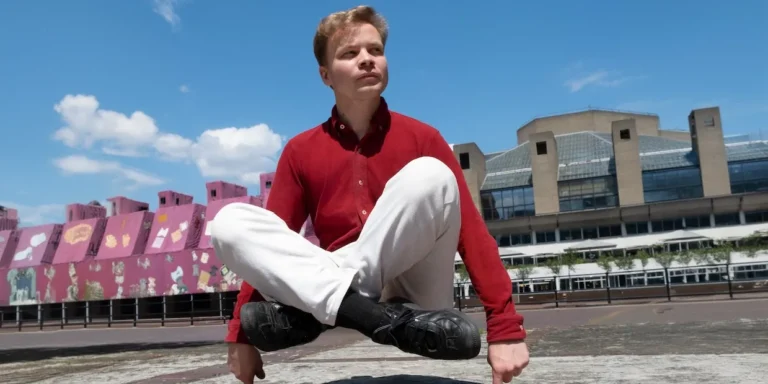

On Friday, Geordie Greep will release his debut solo album The New Sound. It’s his first release since announcing the hiatus of former band black midi, and on it he works with a diverse set of musicians spread across the vast metropolises of Sao Paulo and London. Jack Parker spoke to Greep about the album, its grand compositions and the situations which formed the foundations of its creation.
Hey Geordie. You’ve got your debut record The New Sound coming out next week. How do you feel about it now that release day is creeping up?
I’m excited! I’m more confident every day about this album and I think it’s going to be really cool.
News of the record came quite quickly after the news broke that black midi were entering a hiatus period. Was the reaction from fans a bit how you expected it to be?
To be honest, that was a very strange scenario where we didn’t say anything because we thought it would be very obvious. Eventually it wasn’t very obvious and people just kept asking what happened to the band. On a whim I just said this not expecting anyone to believe me, because I’d always say stuff like this during live streams – making little jokes, being over the top and silly. But then it ended up on NME and I thought, “what?”.
Fair enough.
Because it is the truth, but who cares? It’s probably not the best way to have done it, but what can you do?
I mean, you’re here now and you have the album coming up. It’s about moving forward, isn’t it?
Yeah. The thing is, I hate this kind of stuff. By that I mean always having to do things the correct way with the whole media machine, fresh releases and all that crap. I’d rather just be honest about whatever the state of affairs is. If anyone wants to get annoyed by it, fine. I just thought it was strange.
You know how the media can run with something before it fully changes course. But let’s talk about the new album! You worked with a vast array of musicians, including a number of Brazilians. What drew you to this particular approach and sound?
It’s music I’ve been a fan of for a long time, for years in fact. You’ve got the salsa sounds, Fania Records, Milton Nascimento, Egberto Gismonti, all that stuff. Funnily enough, I’d never gotten into Brazilian music – I got into each of these artists separately, years apart from one another. And then I found myself liking them equally, which made me realise that I really like Brazilian music. I never consciously decided I’d get into it, though. It just happened.
There wasn’t some initial kind of deep dive.
Exactly. I’d never gone into Brazilian playlists and such. But for example Egberto Gismonte, I know every tune he’s done. And yet on the other hand there are some really famous Brazilian songs, and I won’t really know it. It was only a matter of time before it showed up in my own music, to be honest. Even as far back as black midi there were songs which had certain kinds of song structures. One example if the totally bossa nova chord structure on Dangerous Liaison, from the Hellfire album.
It’s this idea of using lots of transposition and funny slash chords, as well as funny inversions or picking patterns. In a classic black midi way this always occurred consciously and subconsciously. The goal would be to take something like that and shift it to make it crazier, or to just put a weird spin on it. This wasn’t something which was forced on me, it was what I wanted to do at the time even if it kind of coincided with doing a solo album. On The New Sound there’s a song like Terra which has very interesting stuff going on instrumentally, especially in the groove. It’s very ‘straight’, so anything interesting comes from the performance, the lyrics, and the delivery. Even Holy, Holy had that, which is the main difference between this album and the past. There was a more disciplined attitude to the music.
I wanted to bring up Terra and Holy, Holy funnily enough. Can you tell me more about the individual composition processes of these two songs?
Both of those songs were recorded in Sao Paulo, and I feel like they benefit from that environment greatly. To me the bass and drums on these songs sound extremely satisfying, even more so given they’re back to back on the record. Even if you don’t like the tune, the lyrics, the composition or whatever, you can just listen to the instrumental and there’s something nice about it. This is something I was very keen to focus on with this record, different ways of just making the music inherently satisfying. More listenable, replayable. Compositionally, both these songs were done really, really quickly. For Terra I had the riff and chords within five minutes, piecing it all together bit by bit. I recorded the demo at home and added loads of synthesisers. The hard part was coming up with the vocals, which took ages. I kept trying out different verses and choruses that I didn’t like, before eventually getting to what’s on the album now. I think it’s good, but it’s not my favourite.
Holy, Holy was the same sort of thing. I came up with the lyrics first, and then I went to the cinema to see La Dolce Vita. After about fifteen minutes I kept thinking of this particular groove, and then this bass line (Note: at this point, Geordie impersonates the guitar and bass lines on Holy, Holy for a solid thirty seconds). They kept crossing over, these two elements, yet changing at different times. I was like, “ah, that’s nice”, and then I ended up paying no attention to the rest of the movie at all! I was just trying to remember this riff, while deciding where the chords would go, how the chorus would sound, et cetera. Then, halfway through the movie, there’s this false religious idol being carried around while all these children keep saying “holy, holy”. I knew there and then that this was my chorus.
I went home after the movie and recorded the demo straight away, and I played it all the way through in one go. For the outro I came up with the chords on the spot, and then everything was set in stone. We recorded that demo in the studio and then sent it to some musicians in Brazil ten months later.
That’s very interesting. I bet you couldn’t wait for the movie to finish, right?
Well, it’s a fucking three hour long film. I was sat there all like, “bloody hell, I’ve got something here”. I just kept looking to my left and to my right in the cinema, which is kind of funny.
Speaking of funny, there’s a moment on the album at the end of Wake Up which felt quite comical. What the fuck was going on there? It’s very cowboy-esque.
Haha, that came quite late in the process. There was a period where the album was done and myself and Shank [aka Seth Evans, producer] were in this little studio room adding bits for fun, just doing silly stuff. That’s where that ending came from, as well as the lead guitar riff at the start of Holy, Holy. We recorded so many extra bits that didn’t end up on the album because they were too stupid. But to go back to Wake Up – we pretended we were all in a bar listening to the song on the radio; it’s a similar joke to what we did during black midi’s KEXP at Home live session. The song ends and we all start talking over it in a bar, and I thought that was cool. It’s obviously shit, but in a way it just works with how Shank sings all Nina Simone.
Narration has always been a heavy element across lyrics on your songs. Are we hearing the same character narrate this album or is it different stories from different points of view?
It’s not necessarily the same character, and more than before I’ve tried to step away from the idea of fleshing out an entire character. On past albums I would always mention people by name and come up with faux mythologies and some sort of chronology, a thread throughout the album, but on this one I just thought, “who cares?”. I wanted to create an atmosphere instead, as well as scenarios and weird environments which didn’t require the need for an exact character. It’s not necessarily an everyman, but more a hypothetical character, you know? There are crossovers here and there, but I didn’t really care. I was more interested in creating nice scenes where you listen to the music but you can also picture things playing out in your mind. It was a different kind of approach.
Right. Aside from Brazil, you also did parts of the record in London. I feel like London has more in common with Sao Paulo than one might think, but what were the biggest differences you noticed in how you approached each location?
Well, each time we worked with a different set of musicians first and foremost, which in itself felt like a fresh start. We were always starting from scratch a little bit. In Brazil the main thing I noticed was how enthusiastic the musicians were without having ever heard of me, my music or black midi before. Everyone I worked with in London knows me to some extent, or had been friends I’ve been working with for years. The Brazilian studio musicians had no connection to me or my music, and I also didn’t know them at all. It meant there were no preconceived notions going into it, really, which made it feel like a new session entirely. The musicians were also straight up guys, they were all about the music, getting things right and nailing the right takes. They were amazing.
Would you take this same approach again in the future?
Absolutely, at the drop of a hat. It all came together, you know? Imagine how it would sound with even more preparation. I gave the Brazilian musicians chord charts that were pretty basic, and I sent those across a week before we started. It was never going to get worse with actual sheet music to read off, or maybe even a rehearsal. I’d definitely be excited to try record an album with a group of new musicians in another country.
Have you got a mental bucket list of places you’d love to work with musicians in?
Of course. I’d love to record in Japan, I’ve been there lots of times in the past and played with great musicians there. There is a very nice music community in Japan, so that would be fun. Perhaps Eastern Europe, or somewhere like Italy would be interesting too. I’d also like to go back to Brazil, but also somewhere like Puerto Rico or Cuba. And America, of course. I’ve been working with different musicians in each territory on a live front too, for example there’s one band I’m playing with in Europe and the UK, and in America there’s another band of New Yorkers who I’m also playing with. We met and rehearsed the weekend before the shows, and then had four brilliant gigs together. I’d love to keep building these relationships with different musicians in different places and then be able to go on tour and record with them. By the time I’m 35 I would love to have someone in every country to play with, you know? A real network.
Was The New Sound written in a way that would help inform this “different live bands” approach, or was the idea born out of the recording sessions?
Both! I’ve always wanted to do stuff like this. When we were touring with black midi I’d always run into great musicians and see them play with these amazing bands. I’d see them have a good appreciation, understanding and appetite for music or whatever else, and I’d notice it a lot in other countries. And then I’d never pursue it as we had a good thing going with the band. In rock music, the ‘band’ is biblical. You’re meant to just play in a band without chopping and changing who’s in it. It’s a band, you know? But with this approach we can be a bit more malleable. I can see what suits each tour or each separate occasion, and it’s exciting to try that.
I’ve always been interested in doing live shows which are very different to the album, where you have songs that lend themselves to be played in different ways. That was the aim of black midi, to have this show where anything can happen. With Brazil, I realised that you can probably find people in a lot of places who are willing to collaborate and who are willing to try and play some shows. It’s what I wanted, and it’s also what seemed possible and the right thing to do.
There’s one song which made it onto the album from the black midi days – The Magician. What is it about a song like that which lent itself well to both the worlds of black midi and of The New Sound?
We played that song in black midi and it was cool. The vibe was good and people were into it, but I felt like it could have been done differently. So for The New Sound, I wanted to take The Magician in a very different direction and play it as more of a song. I wanted to take advantage of its song aspects.
It’s quite the grand composition.
Yeah man, it’s very melodramatic and over the top. It’s important to have the lowbrow and the highbrow, or the good taste and the bad taste, working together and informing each other. It’s a song that can be played in a million different ways, you know? For over half of it there’s just four chords going round and round and round and round and round. So when you have four chords going round and round and round and round and round, there’s no right way to play it. It’s more about trying different things, and so for my vision of this song I was going through all these different textures. At first there’s a piano playing it, then some guitars, and then an orchestra. There’s these shifting formations and structures, which felt very natural. I was also very happy with how the lyrics and music came together, as it’s one of these songs that is more about the basic form of songwriting as opposed to how it’s supposed to be played. The New Sound is out on Friday (4 October).
